European Nightcrawlers as a compost worm

I am often asked the practical difference between Euro's and red wigglers when it come to composting. There are some differences between the Euro and the red wiggler, but the Euro is in-fact a decent compost worm as long as a few things are understood about it.
While the Euro is called a nightcrawler it is in-fact a red worm by scientific classification. The scientific name for the red wiggler is Eisenia fetida and the name for the Euro is Eiseia hortensis. We can see from this that they share a lot of characteristics in common and are very similar in there design.
Euros are a lot larger than red wigglers and take longer to reach maturity than red wigglers. This results in longer time before they begin to reproduce in the bin in large numbers. This also means that they take longer to bounce back if something happens to your worm bin. They consume similar quantities of food per amount of worm weight, but are more particular to proper carbon-nitrogen ratios. (That is essentially the ration of food to bedding.) One other important fact about euros is the fact that they are more prone to crawl from the bed when things are not exactly right. To overcome this just be more careful to keep everything in balance and having a light over the bin can be a real help in preventing crawl outs.
They are many things about the euro that make some prefer it over the red wiggler. One is that its physically larger size make it easier to harvest by hand and some fishermen prefer the bigger worm. The egg capsules are easier to spot which make it great for class room instruction and the worms larger size make it easier to study. They provably survive better in a garden soil with less organic material than the red wiggler but either worm needs a specially prepared garden with LOTS of organic matter to survive.
One great way to use the Euro is in a worm bed that has both types of worms in it. They do fine together and that way the advantages of each worm can bring benefits to the composting system.
Related posts
Worm Castings Video
Video by http://www.youtube.com/user/Praxxus55712
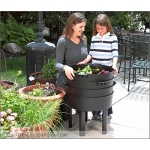
Can-O-Worms Composter System Review and Instructions
Can-O-Worms Composter System Review and Instructions. The manufacturer did a great job thinking the system out. They included everything start vermicomposting
Composting made simple using red worms. Indoors!
Composting food scraps is easy and fun to do even in ones home. Most food scraps can be composted as long as they don't contain